Reform the Mental Health Act
We welcome the final passage of the Mental Health Bill 2024.
Click the link below to read our statement in full
What is the Mental Health Act, 2001?
The Mental Health Act, 2001 is legislation that governs the rights of people who are admitted and treated in an in-patient facility for mental health care.

Why should it be reformed?
The Mental Health Act, 2001 is outdated, it does not comply with international human rights standards, and does not adequately protect people’s rights.
The reform of the Act is a key step in the transition towards person-centred, recovery-focused services, as set out in our national mental health policy, Sharing the Vision. We now have an opportunity to be world leaders in the delivery of mental health legislation that adequately protects people’s human rights, and respects their will and preferences.
The Government has promised to reform the Act for over seven years now, it is a commitment in the Programme for Government and it is time to hold them accountable.
Mental Health Bill Committee Stage Summary
Committee Stage of the Mental Health Bill in the Seanad marked an important step in the ongoing reform of Ireland’s mental health legislation. While several of the changes represent meaningful steps forward and reflect the sustained advocacy of Mental Health Reform, our members, supporters, and people with lived experience, we remain convinced that the Bill can and should go further to fully uphold the rights of people with mental health difficulties. Continued political engagement will be crucial as the Bill moves to Report Stage, where there remains a real opportunity to strengthen protections and deliver a more rights‑based mental health framework.
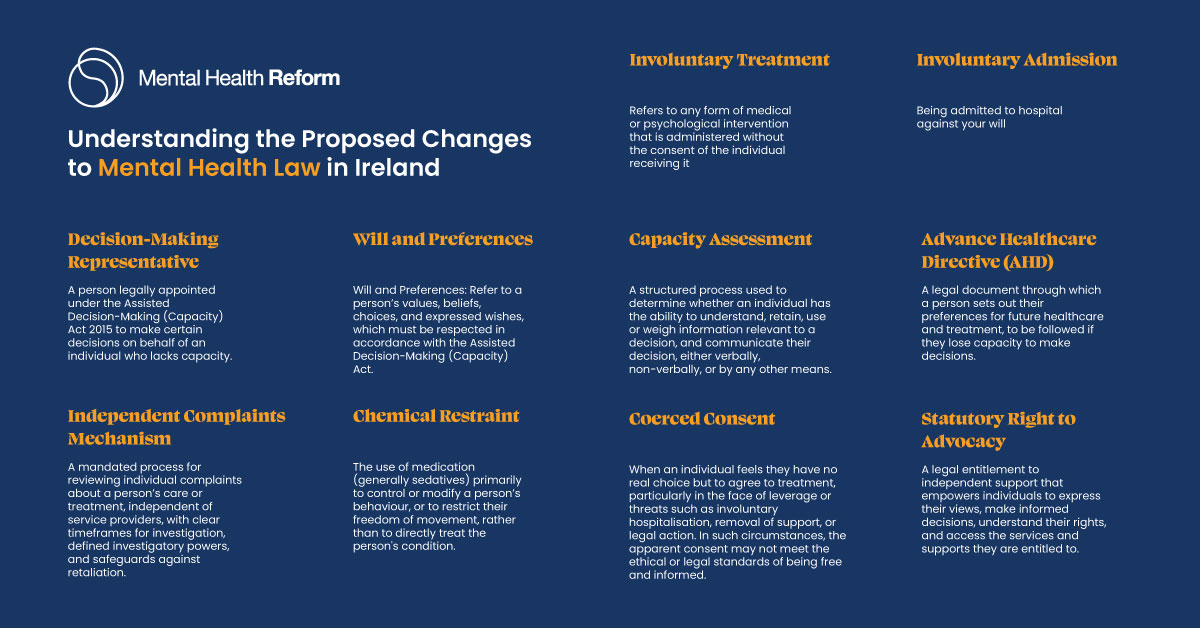
Understanding the Proposed Changes to Mental Health Law
Understanding the Latest Amendments to the Mental Health Bill 2024
Click to view our webinar recorded August 2025, where we discuss hopes , concerns and recommendations for the Mental Health Bill 2024
Previous Webinars
Latest Developments
February 2026
Mental Health Bill Committee Stage Summary
Committee Stage of the Mental Health Bill in the Seanad marked an important step in the ongoing reform of Ireland’s mental health legislation. While several of the changes represent meaningful steps forward and reflect the sustained advocacy of Mental Health Reform, our members, supporters, and people with lived experience, we remain convinced that the Bill can and should go further to fully uphold the rights of people with mental health difficulties.
Read the Summary Factsheet here.
October 2025
Plain English Guide to Mental Health Bill amendments
Mental Health Reform has launched a new Plain English Guide to the Mental Health Bill amendments. The guide is designed to help the public better understand the proposed changes to Ireland’s mental health legislation.
Read the Plain English Guide here.
September 2025
Seanad Second Stage Debate
The Mental Health Bill came before the Seanad for Second Stage debate on Wednesday, 24th September. At Second Stage, Members debate the motion “That the Bill be now read a Second Time”, which provides an opportunity to discuss the general principles of the Bill, what it contains, and what might appropriately be included.
The Bill will return to the Seanad for Committee Stage in the coming weeks. Committee Stage involves a section-by-section review of the Bill, with Members considering proposed amendments and taking separate decisions on each part.
Mental Health reform will continue to engage with government representatives and monitor the bills progression.
August 2025
Concerns & Recommendations
The Mental Health Bill has recently passed Committee Stage and is due to progress to Report Stage in the coming weeks. It represents a significant step toward modernising Ireland’s mental health laws in line with human rights and international best practice. Mental Health Reform (MHR) welcomes the amendment to review the Act every five years instead of ten—a positive move toward more responsive legislation. However, we have raised concerns about some recently agreed amendments approved at committee stage and are actively engaging with the Minister’s office to urge changes at Report Stage. We also continue to highlight omissions in the Bill that we have previously highlighted, such as the need for independent advocacy.
Please see our update for a full outline of our concerns and recommendations.
June 2025
Committee Stage Passed
The Mental Health Bill 2024 has just passed Committee Stage, after being debated section by section in the Dáil. This part of the process allowed for detailed consideration of the Bill and for changes to be made before it moves forward to Report Stage.
A significant number of Government amendments have been introduced at this stage. Mental Health Reform welcomes the continued progress of the Bill and is now carefully reviewing the proposed changes to assess their impact on people’s rights and access to mental health supports.
Over the coming weeks, we will be going through the amendments in detail and sharing our analysis. We are also planning a public webinar to help explain what these changes mean for people using mental health services, their families, and supporters.
Mental Health Reform remains committed to ensuring that the new Mental Health Bill is rights-based, recovery-oriented, and reflects the voices of people with lived experience.
May 2025
Where the Bill is at…
July 2024
Mental Health Reform, welcomes Cabinet approval of the Mental Health Bill.
Fiona Coyle, CEO, Mental Health Reform commented: “We welcome this important step taken by the Government to progress Ireland’s new mental health laws. There is an urgent need to reform the Mental Health Act, 2001 to protect the rights of people receiving mental health treatment and care in in-patient settings.”
July 24, 2024
Cabinet approved the publication of the Mental Health Bill 2024
August 1, 2024
Minister for Mental Health and Older People announced the publication of the Bill.
September 19, 2024
The Bill passed the Second Stage in Dáil Éireann, allowing for general debate on its principles.
February 7, 2025
Minister for Mental Health, Mary Butler TD, confirmed the restoration of the Bill to the Oireachtas legislative programme, with plans for further consideration at Committee Stage before Summer recess.
What we want to see reformed
It’s essential that we protect the rights of children and ensure they receive age-appropriate care. Admitting children to adult inpatient units is not acceptable and must be addressed in the reformed Mental Health Act. However, Head 128 of the Draft Heads of Bill allows for children under 18 years to be admitted to approved adult inpatient facilities. Concluding observations from UNCRC state that the Committee is seriously concerned about Ireland’s practice of admitting children to adult units.
It’s crucial that people have access to someone who can help them understand their rights, navigate the mental health system, and help them advocate for their needs. People receiving mental health care on a voluntary basis currently do not have basic rights to information and advocacy. This can leave them feeling unsupported and without a voice in their own care.
Currently, young people aged 16 and 17 cannot consent to or refuse mental health care, even though they can do so for physical health care. This is a significant gap in their rights and can impact their ability to access appropriate treatment. For more information, please see the Mental Health (Capacity To Consent To Treatment) Bill 2018 and 2021 and related debates.
An Advanced Healthcare Directive is an important tool for individuals to have control over their healthcare decisions. The recently commenced Assisted Decision-Making (Capacity) (Amendment) Act 2022 enshrines this as a right. However, under this legislation, some people with mental health difficulties who are detained under Section 3(1)(b) of the Mental Health Act, 2001 have been excluded and do not have the right to have their advance wishes about treatment respected. This discriminatory exclusion needs to be addressed in the reform of the Mental Health Act, 2001 as promised by the Government.
Article 25 of the UN Convention on the Rights of Persons with Disabilities (UNCRPD) says that people have a right to care as close to their own community as possible. Sharing the Vision states that our “…mental health system should deliver a range of integrated activities to promote positive mental health in the community; it should intervene early when problems develop; and it should enhance the inclusion and recovery of people who have complex mental health difficulties” (p. 16). Involuntary detention should be a last resort and alternative support systems should be explored wherever possible.
Individuals with complaints relating to mental health services must have confidence that their complaints be handled fairly and impartially. This needs to be separate from the existing HSE “Your Service, Your Say” complaints mechanism and available for both children and adults. For more information on the need for an independent complaints mechanism, please see the Human Rights Analysis of the Draft Heads of Bill.
What do we need?
- Full reform of the Mental Health Act, 2001
- Human Rights, UNCRPD and UNCRC compliant legislation
- Priority scheduling of the Draft Reform Bill in early 2024
Get Involved!
There are a number of ways you can get involved in our campaign to reform the Mental Health Act, 2001:
- Contact your TD – Email your local elected representatives and ask them to prioritise the reform of the Mental Health Act
- Subscribe to our newsletter – Keep up to the date with the campaign by subscribing to our newsletter
- Follow us on social media – We are on LinkedIn, Twitter, Instagram and Facebook
Get Social and spread the Word...
In September and October 2024 we held a number of capacity building webinars on the Mental Health Bill 2024. In these sessions, we discussed the proposed key changes in the legislation and what they will mean for people accessing mental health services in the future.
The new Mental Health Bill will replace the Mental Health Act, 2001 which governs the rights of people who are admitted and treated in an in-patient facility for mental health care.
The sessions were an opportunity for the public to learn more about the Mental Health Bill 2024, and share any questions or concerns.